MBZUAI’s Institute of Foundation Models has published the full technical paper for K2-Horizon, the six-model open family it first released in September. The paper, submitted to arXiv on 16 November, gives the most detailed public account yet of a release the institute calls the largest fully open model drop in AI history.
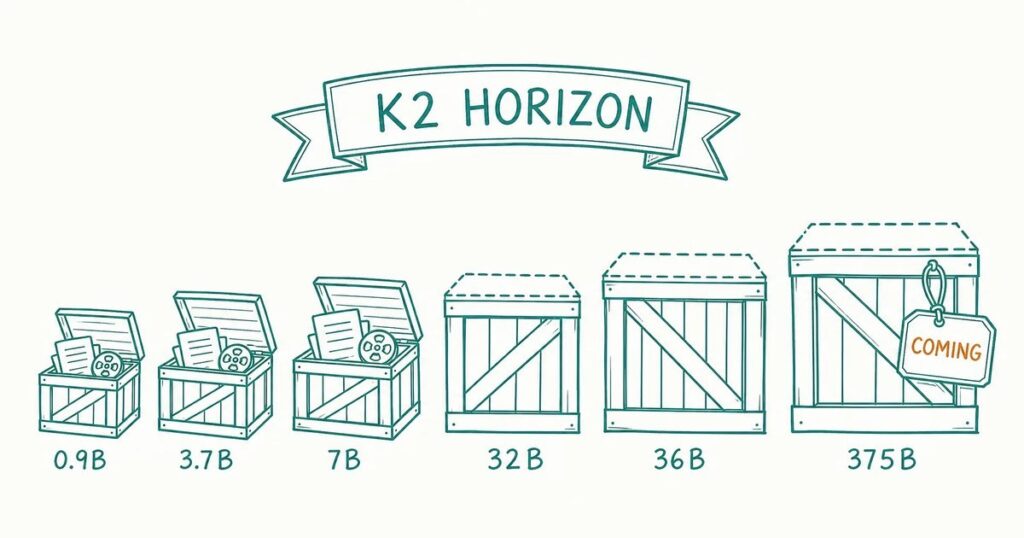
The family spans a 0.9B model small enough for edge devices through 3.7B, 7B and 32B dense models to two mixture-of-experts designs: a 36B model with 4B active parameters per token and the 375B-A23B flagship, which activates 23 billion of its 375 billion parameters per token and offers a 512,000-token context window. All six are released under the Apache 2.0 licence, aimed at reasoning, coding and agentic workloads.
The flagship’s headline result is a score of 65.3 on Toolathlon-Verified, which the paper reports leads open rivals including GLM-5.2, MiniMax M3 and Nemotron 3 Ultra. It also scores 48.4 on SWE-Atlas-QnA for repository-level code. Notably, the institute audited its own Terminal-Bench 2.1 result and corrected it downward, from 70.2 to 66.9, after removing 24 flagged trials, a level of transparency rarely seen in model releases.
Openness comes with a caveat. The smaller models shipped with training data, code and checkpoints, but the two largest models’ data and training code were still marked as forthcoming at launch, so the paper is the right moment to check whether those gaps have closed. The flagship trained on 15.1 trillion tokens across two phases on NVIDIA H200 GPUs and ships in FP8 and NVFP4 quantisations, with the smaller models also available in GGUF and MLX builds for local use through tools such as Ollama and the Hugging Face hub.