
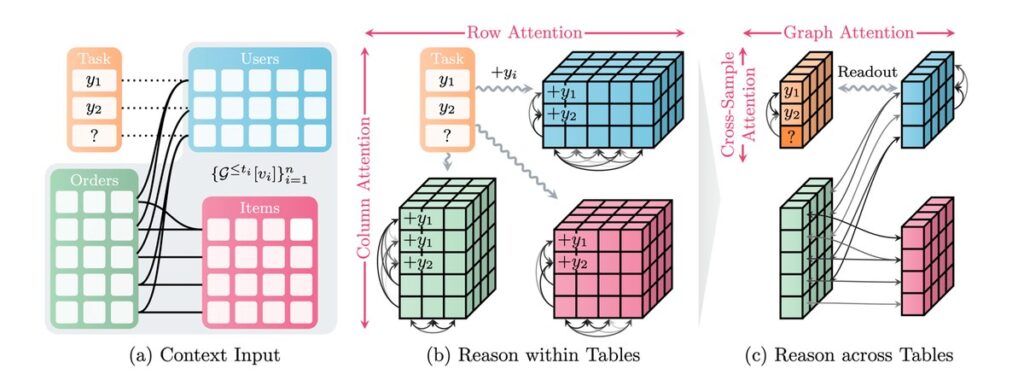
NVIDIA has published Kumo Relational, the first few-shot foundation model designed to make predictions directly from enterprise relational databases — and it beats XGBoost, the decade-long standard for tabular machine learning, without a single hand-built feature.
The mechanism is in-context learning. The model accepts up to 10,000 historical database records as context examples in one forward pass and returns predictions without updating its weights. Architecturally, a Relational Graph Transformer reasons natively over tables, using graph attention across primary-key and foreign-key relationships instead of flattening data into a wide table first.
The benchmark results reported by NVIDIA are striking. Across 41 tasks on 15 relational databases — spanning e-commerce, medical, enterprise, social, and academic domains, none of which appeared in pre-training — Kumo Relational outperforms supervised relational models and expert-engineered gradient-boosted pipelines. On RelBench V1 classification, it beats XGBoost-based pipelines by nearly four AUROC points on average. On the SAP SALT enterprise benchmark, it surpasses large AutoGluon ensembles by 8% in mean reciprocal rank out of the box, extending to 16% after fine-tuning, and tops rival tabular foundation models by about 25%.
The model is available through NVIDIA’s open-source structured-data-models library (Apache 2.0) and as an NVIDIA NIM deployment, with weights published on Hugging Face under the OpenMDW license, which permits commercial use with restrictions. Its Predictive Query Language is designed to be called by software agents — the same class of coding agents now automating software work — turning each new business question into a query instead of a project.
NVIDIA is candid about the limits: in-context predictions are capped at 10,000 context examples, so on tasks with very large labeled training sets, task-specific supervised models may still win, with fine-tuning as the recommended path.
Source: Tech Times, Hugging Face