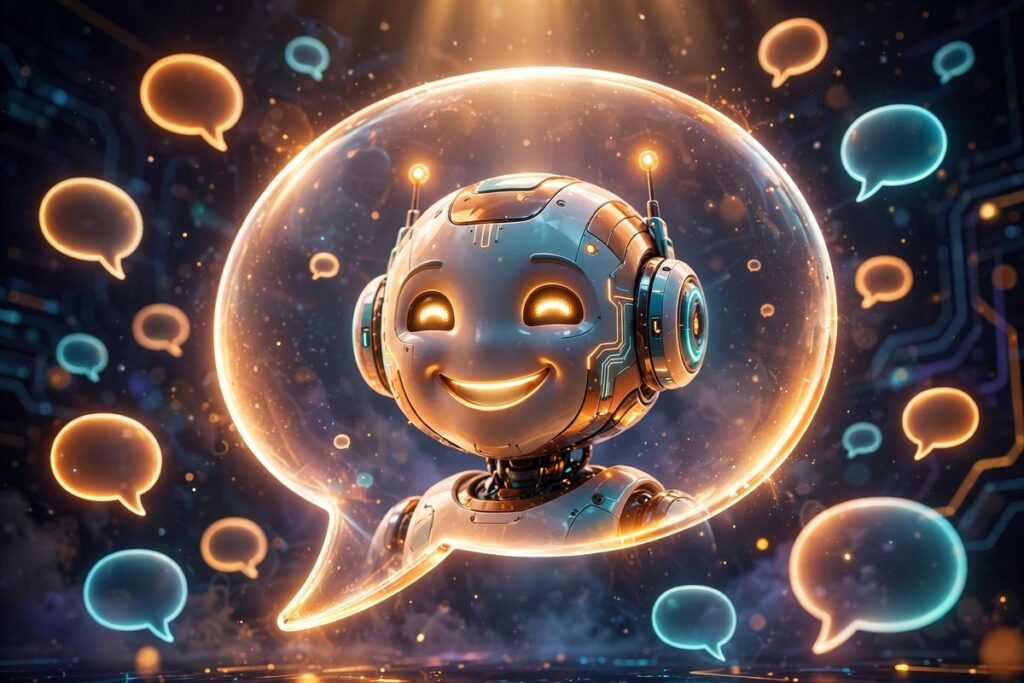
A chatbot is a software program that holds conversations with people through text or voice. It reads what you type, figures out what you mean, and replies in a natural way. Chatbots answer customer questions, take orders, book appointments, and help users around the clock without a human agent.
How It Works
Think of a chatbot like a very fast, tireless receptionist. When you send a message, the chatbot first reads your text and tries to figure out your intent — what you actually want, not just the literal words. Modern AI chatbots break your sentence into meaning, match it against things they know, and then build a reply in natural language, one word at a time.
Older chatbots were simpler: they followed a fixed script, like a choose-your-own-adventure book. If you typed something they did not recognize, they would just say, “Sorry, I did not understand.” Today’s AI chatbots are different. They are powered by large language models that have read enormous amounts of text, so they can handle unexpected questions, rephrase answers, and keep track of a conversation across many messages.
Behind the scenes, a chatbot usually connects to a company’s real systems. A support chatbot can check your order status, a bank chatbot can look up your balance, and a booking chatbot can actually reserve your table. The conversation is the friendly front door; the real work happens through secure connections to databases and services in the background.
Why It Matters
Chatbots matter because they are always available. A human support team sleeps; a chatbot answers at 3 a.m. on a holiday. For businesses, that means no missed questions and happier customers. Most routine questions — “where is my order,” “how do I reset my password” — can be answered instantly by a bot, freeing human agents for the tricky cases that need judgment and empathy.
For users, chatbots remove friction. Instead of digging through help pages or waiting on hold, you just ask. That convenience is why chatbots now appear everywhere: on websites, inside messaging apps, in banking apps, and even on phone lines as voice assistants.
Real-World Example
Imagine you buy a pair of shoes online and the package is late. It is 11 p.m., and you do not want to wait until morning. You open the store’s website and a chat window pops up: “Hi! How can I help?” You type, “Where is my order?” The chatbot asks for your order number, looks it up instantly, and replies, “Your order shipped yesterday and arrives Thursday. Here is the tracking link.” Problem solved in under a minute — no hold music, no waiting.
Now imagine you are the store owner. Instead of staffing night shifts, your chatbot handles hundreds of these conversations every day, and only the complicated ones — a damaged item, a refund dispute — get passed to a human with the full conversation history attached.
Popular AI Tools
To see modern chatbots in action, try Intercom Fin, an AI support agent that resolves customer questions inside the Intercom platform; Tidio, a chatbot builder popular with small online stores; or Ada, an enterprise-grade AI agent used by large brands to automate support conversations.
Frequently Asked Questions
Is a chatbot the same as ChatGPT?
Not quite. ChatGPT is a general-purpose AI chatbot anyone can talk to. The word “chatbot” is broader — it covers any program that chats with you, from a simple pizza-ordering bot to a smart assistant like ChatGPT. Think of ChatGPT as one famous example of a chatbot.
Can chatbots replace human support agents?
For routine questions, largely yes — and they already do. But humans still win at complex problems, emotional situations, and anything requiring real judgment. The best setups use chatbots as the first line and hand off tricky conversations to people.
Do chatbots work in other languages?
Most modern AI chatbots handle dozens of languages because the models behind them were trained on multilingual text. Simpler rule-based bots usually only support the languages they were programmed for.
Are chatbots expensive to build?
It depends. No-code chatbot builders let a small business launch a basic bot in an afternoon at low cost. A custom AI chatbot connected to a company’s internal systems takes more time and budget, but off-the-shelf platforms have made it far cheaper than it used to be.