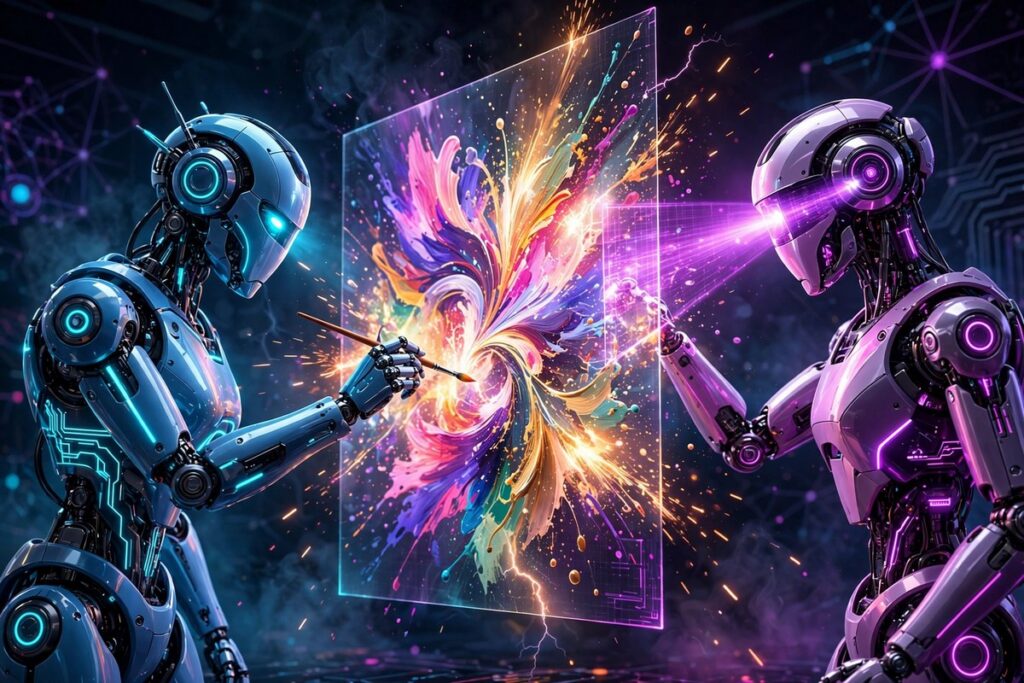
A GAN, or generative adversarial network, is an AI system made of two neural networks that compete against each other: a generator that creates fake images and a discriminator that tries to spot the fakes. This rivalry pushes both to improve until the generator produces images so realistic the discriminator can no longer tell them from real photos.
How It Works
A GAN sets up a creative duel between two neural networks. The generator’s job is to create fake data — say, images of faces that don’t exist. The discriminator’s job is to examine images and judge: real or fake? At first the generator is terrible, producing obvious fakes the discriminator easily catches.
Picture a forger and an art detective locked in a contest. Each time the detective spots a fake, the forger studies the mistake and improves. Each time the forger fools the detective, the detective sharpens their eye. Round after round, both get better — until the forger’s work is indistinguishable from the genuine article.
This adversarial training continues until the generator produces images so convincing the discriminator can only guess. The result: AI that can invent photorealistic faces, enhance blurry photos, or imagine new designs. The competition itself is the teacher — no human labels every step.
Why It Matters
GANs were the first AI to generate truly convincing fake imagery, and they changed what’s possible. They power photo restoration (turning damaged old photos into clear ones), realistic avatars, fashion design mockups, and medical imaging — where GANs can generate synthetic scans to help train diagnostic tools without using real patient data.
They also introduced the world to deepfakes — realistic fake videos — sparking important debates about misinformation and consent. Understanding GANs helps you understand both the creative promise and the risks of generative AI, and why detecting AI-made media matters.
Real-World Example
A website needs profile photos for fictional characters in a demo — but using real people’s photos would be wrong. A GAN trained on faces generates dozens of realistic but entirely fictional portraits. Nobody in the pictures exists, so there are no privacy issues, yet the demo looks completely lifelike. Designers can even dial specific traits — age, lighting, expression — generating endless variations until the cast feels just right.
Popular AI Tools
These creative platforms grew out of GAN-era image generation:
- NightCafe — an easy AI art studio with community challenges.
- StarryAI — turn text prompts into shareable artwork in seconds.
- Leonardo AI — a production-grade creative suite for game and design assets.
Frequently Asked Questions
What does GAN stand for?
Generative Adversarial Network. “Generative” because it generates new content, “adversarial” because its two networks compete against each other, and “network” because both are neural networks.
Are GANs still used now that diffusion models exist?
Yes. Diffusion models lead in text-to-image quality, but GANs remain popular for tasks like image enhancement, style transfer, and real-time generation, where their speed is a big advantage.
What is a deepfake?
A deepfake is a GAN-made (or now diffusion-made) video or audio that realistically swaps someone’s face or voice. The same technology that entertains can also mislead, which is why many platforms label or restrict synthetic media.
Can GANs generate things besides images?
Absolutely — GANs can generate music, voices, and even 3D models. Anywhere you need realistic synthetic data, the generator-vs-discriminator contest can be applied. Researchers also use GANs to create rare training examples, like unusual medical conditions, so other AI systems can learn from scenarios that barely exist in real datasets.