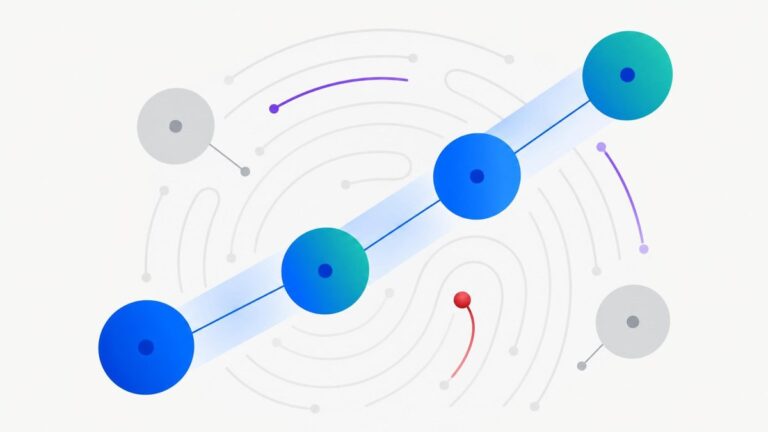
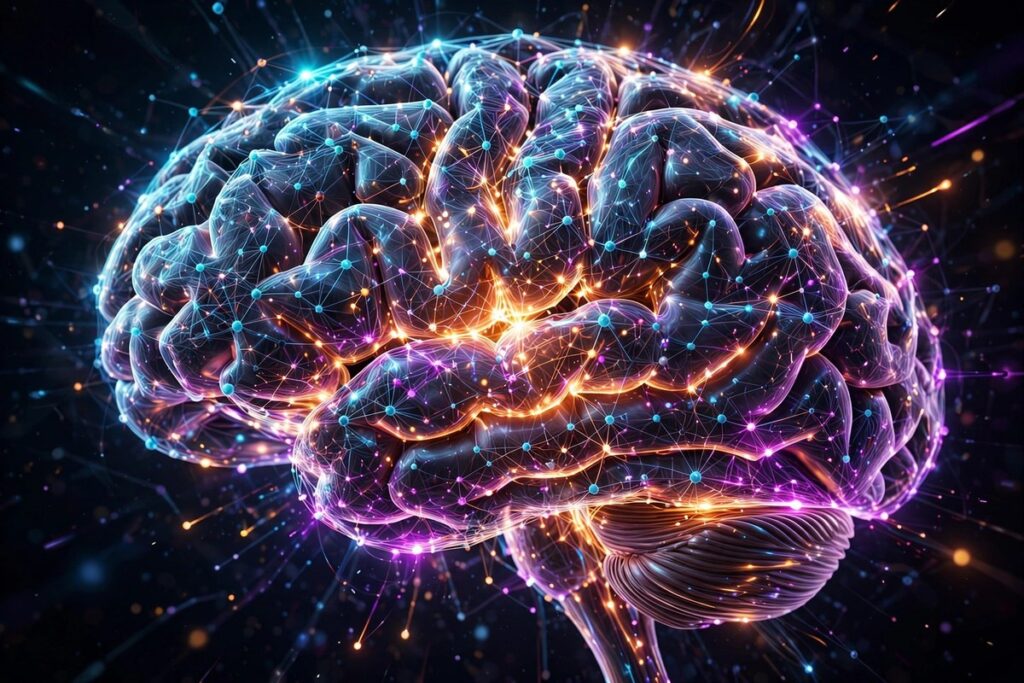
A neural network is a computing system inspired by the human brain, made of layers of simple processing units called neurons. Each neuron receives inputs, applies a weight, and passes the result to the next layer. By adjusting these weights while training on data, the network learns to recognize patterns like faces, speech, or language.
How It Works
Imagine a long line of people passing notes. The first person looks at a photo and writes down what they see, edges and colors, and passes the note along. The next person combines those notes into shapes, the next into objects, and the last person announces, “That is a cat.” A neural network works like this relay team: layers of artificial neurons each transform the information a little, until a final answer emerges.
Each connection between neurons has a weight, a number that says how much influence one neuron’s opinion carries. During training, the network sees thousands or millions of examples and slowly adjusts these weights, strengthening the connections that lead to correct answers. It is like practicing free throws: every miss teaches your muscles a tiny correction, until the shot becomes automatic.
The network has three kinds of layers. The input layer receives the raw data, such as the pixels of an image. Hidden layers in the middle do the detective work, finding edges, then shapes, then objects. The output layer delivers the verdict, like “cat” with 97 percent confidence. Once trained, the network can make predictions in a fraction of a second.
Why It Matters
Neural networks are the engine behind nearly all modern AI. Image recognition, voice assistants, translation, and chatbots all run on them. Their superpower is learning patterns directly from data instead of needing humans to hand-write rules, which is why they conquered problems, like understanding speech, that stumped programmers for decades.
Their power grows with data and computing. Feed a network more examples and give it more neurons, and it generally gets smarter, which explains the race for bigger datasets and faster chips. The trade-off is opacity: a trained network is a black box. It can tell you the answer is “cat,” but explaining exactly why remains genuinely hard.
Real-World Example
Open the photo app on your phone and search for “dog.” In seconds it finds every dog photo you have ever taken, even though nobody labeled them. Behind the scenes, a neural network was trained on vast numbers of dog images, adjusting its weights until it learned the visual essence of “dogness”: fur textures, snout shapes, ear positions.
Now when you search, the network scans each photo through its layers, edges to shapes to objects, and flags the ones that score high for dog. It will occasionally misfire, a fluffy rug might sneak in, because it learned patterns, not the true meaning of “dog.” But its hit rate is astonishing, and it keeps improving as it sees more examples.
Popular AI Tools
- DALL-E 3 – an image generator powered by neural networks that turn text descriptions into pictures.
- ChatGPT – a chatbot built on a giant neural network trained to understand and generate language.
- Gemini – Google’s neural-network-based AI that handles text, images, and video.
Frequently Asked Questions
Are neural networks actually like the human brain?
Only loosely. They borrow the idea of interconnected units that strengthen with experience, but real brains are vastly more complex, and artificial neurons are simplified mathematical functions.
How big are modern neural networks?
Enormous. Leading models contain anywhere from millions to hundreds of billions of adjustable weights, called parameters, and training them requires warehouse-scale computing.
Do neural networks keep learning after training?
Typically no. Most are trained once and then frozen, so what they “know” stays fixed until retrained. Some systems add memory or retrieval on top to stay current.
Why are they called “neural” networks?
Because the design was inspired by neurons in biological brains: simple units that receive signals, process them, and pass results onward through connections.