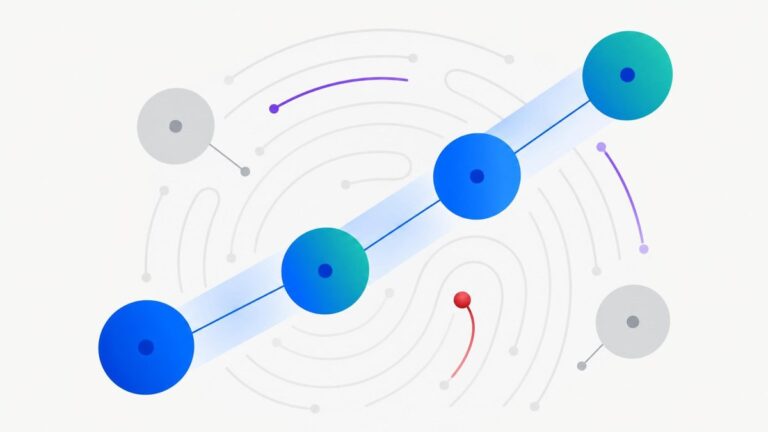
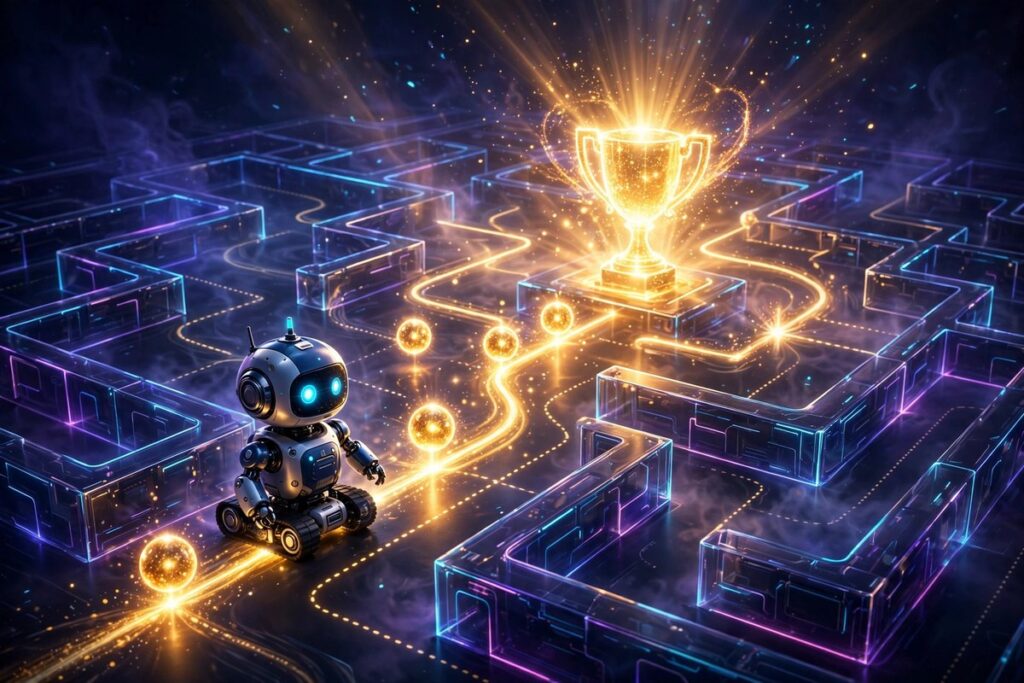
Reinforcement learning is a way of training AI through trial and error, like teaching a dog tricks with treats. The AI agent tries actions in an environment and receives rewards for good moves and penalties for bad ones. Over many attempts, it learns the strategy that earns the most reward, with no human-labeled examples required.
How It Works
Think of a kid learning a video game. Nobody hands them a manual of correct moves. They press buttons, crash into walls, stumble onto a shortcut, and slowly figure out what works. Reinforcement learning trains AI exactly this way: an agent observes its situation, takes an action, and receives a reward signal. Good moves earn points, bad moves lose them, and over thousands or millions of rounds the agent discovers a winning strategy.
A central tension in this process is exploration versus exploitation. Should the agent try a risky new move that might be brilliant, or repeat the safe move it already knows? Too much caution and it never improves; too much experimentation and it never cashes in. Good training balances the two, exploring early and exploiting later, much like a chef who experiments with new dishes but keeps the crowd-pleasers on the menu.
Because real-world trial and error can be slow or dangerous, agents usually train in simulators first: virtual games, virtual robots, virtual traffic. A simulated car can crash a million times in an afternoon with nobody hurt, and the lessons transfer to the real thing. Speed of iteration is the whole game.
Why It Matters
Reinforcement learning conquers problems where nobody can write down the right answers in advance. You cannot label every correct move in a game of chess or every correct steering decision on a highway, but you can define winning and let the agent discover how. That is how AI mastered complex games and how robots learn delicate physical skills.
It also quietly shapes the chatbots you use every day. After initial training, leading AI assistants are refined with reinforcement learning from human feedback, known as RLHF: humans rank responses, and those rankings become the reward signal. This is a big reason modern chatbots are helpful and polite rather than merely fluent.
Real-World Example
Picture an AI learning to play a racing game. In its first laps it is hopeless: slamming walls, spinning out, finishing last. Each crash is a penalty, each clean corner a small reward, each win a big one. After thousands of simulated races, something clicks. It starts braking later, hugging the inside line, drafting behind opponents. Eventually it drives lines no human thought of, because it explored millions of possibilities no human had time to try.
The same pattern appears in warehouses, where robots learn to grasp oddly shaped packages, and in data centers, where agents learn cooling strategies that cut energy use. Trial, error, reward, repeat: simple loop, remarkable results.
Popular AI Tools
- ChatGPT – refined with reinforcement learning from human feedback to give helpful, safe answers.
- DeepSeek – an AI model family known for using reinforcement learning heavily in training reasoning skills.
- Grok – xAI’s assistant, trained with modern techniques including reinforcement learning.
Frequently Asked Questions
What is RLHF?
RLHF stands for reinforcement learning from human feedback. Humans rank or rate AI responses, and those ratings become the reward signal that teaches the model which answers people prefer.
How is reinforcement learning different from supervised learning?
Supervised learning trains on labeled examples of correct answers. Reinforcement learning trains on rewards for outcomes, letting the agent discover its own path to success through trial and error.
Why is it called “reinforcement” learning?
The name comes from psychology, where reinforcing a behavior with rewards makes it more likely. The AI equivalent: behaviors that earn rewards get strengthened in the agent’s strategy.
Does reinforcement learning need humans involved?
Not always. The reward can come from a game score, a simulator, or a mathematical goal. Humans enter the picture mainly for subjective goals like “be helpful,” where only people can judge.